Facts last checked 23 October 2026. Rules change: confirm the details with the office named before you rely on them.
In short
- A civil wedding in Spain needs at least one partner to live in Spain or be a Spanish national.
- There is no fixed '2 years' residency' rule in the law; what counts is legal domicile, usually shown with the padrón certificate.
- Most couples from abroad marry legally at home, then hold a symbolic ceremony in Ibiza.
- A Catholic church wedding has civil effect in Spain, but the papers start at your home parish months ahead.
- Same-sex marriage has been legal in Spain since 2005, under the same rules.
There are three ways to get married in Ibiza, and which one is open to you depends mostly on where you live.
1. A civil wedding in Spain
Spanish law lets you marry civilly in Spain if at least one of you lives in Spain or is a Spanish national. Two foreign partners who both live abroad cannot have a legal civil wedding here. This is confirmed by both the UK and Dutch governments.
You may read online that you need two years' residency. That figure is not in the Civil Registry Law. What the law asks is that the marriage file (expediente matrimonial) be handled where one of you is domiciled, and offices usually ask for the municipal register certificate (padrón) as proof.
If you qualify, the file is handled by the civil registry, a court clerk or a notary, and the marriage can be celebrated by a mayor or councillor, a court clerk, a notary or a consular officer. Notaries have been able to process and celebrate marriages since 2017. Foreign documents (birth certificates, proof of free status) generally need an apostille and a sworn translation into Spanish. British citizens need a certificate of no impediment issued in Spain; the Dutch need a multilingual birth certificate.
There is no legal time limit for the file, and timings vary by office, so start well ahead.
2. Marry at home, celebrate in Ibiza
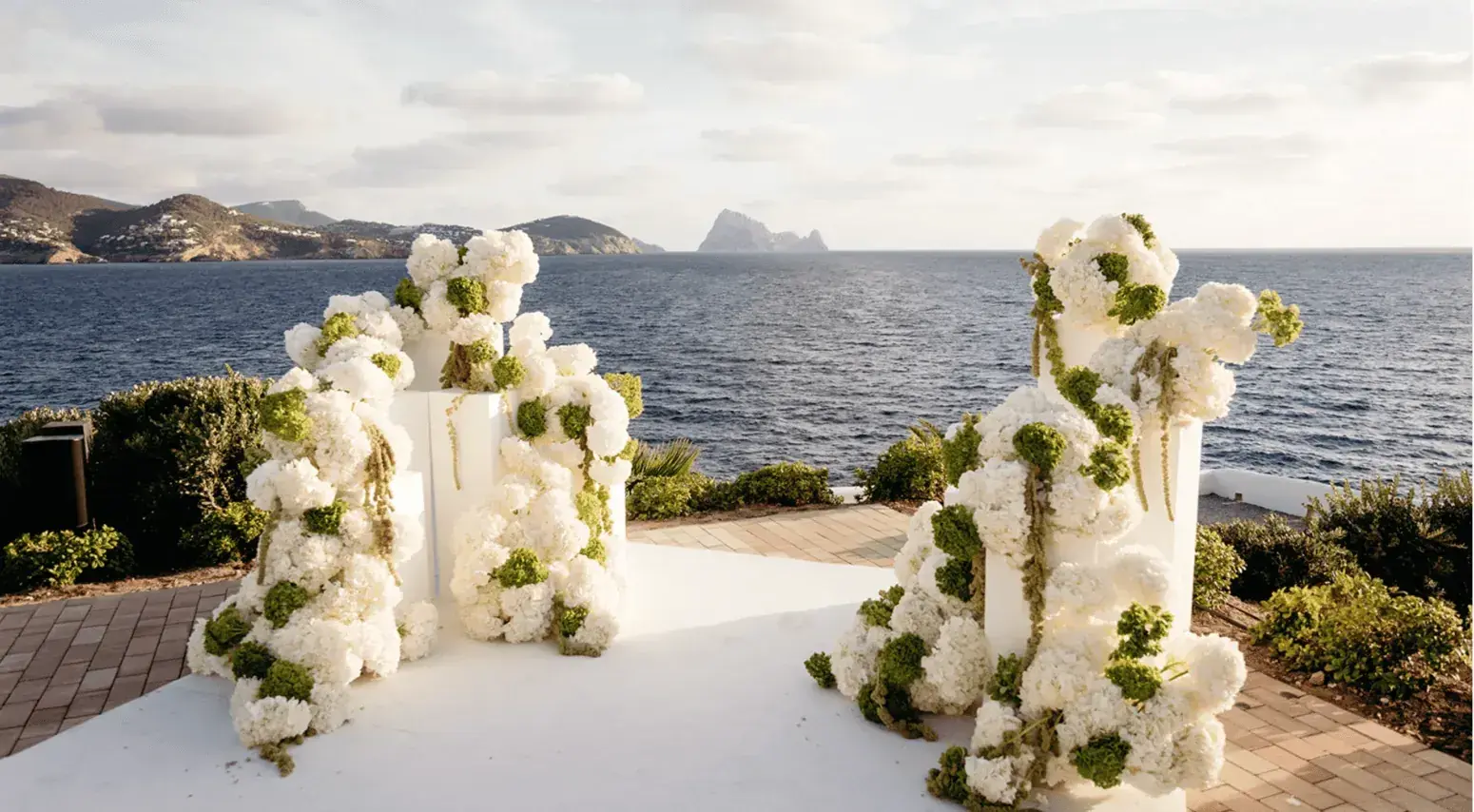
This is what most couples from abroad do. You sign the legal papers at your local registry office, before or after the trip, and hold a symbolic ceremony in Ibiza, led by a celebrant, a friend or family member. It can be as personal as you like, in any language, at any venue: a cliff-top, a villa garden or a beach club.
There is no Spanish or Balearic licensing for symbolic celebrants that we could find. The ceremony has no legal effect, which is exactly what gives you the freedom. See celebrants and officiants.
3. A religious wedding
A Catholic wedding in Spain has civil effect from the moment it is celebrated, under the 1979 agreement between Spain and the Holy See, and is then entered in the civil registry. In practice, for couples from abroad, the paperwork begins at your home parish, which prepares the pre-marriage file and sends it through your home diocese to the Diocese of Ibiza. Allow several months. Read our guide to churches and religious ceremonies.
Weddings of other recognised faiths also have civil effect in Spain, but need the civil capacity file first, which brings back the residency question.
Same-sex couples
Same-sex marriage has been legal in Spain since July 2005. Exactly the same rules apply: a civil wedding needs one partner resident in Spain, and otherwise you marry at home and celebrate here. The Catholic Church does not marry same-sex couples.
Questions
Can we get legally married in Ibiza if neither of us lives in Spain?
Not with a civil wedding: Spain requires at least one partner to live in Spain or be Spanish. Most couples marry legally at home and hold a symbolic ceremony in Ibiza. A Catholic church wedding is a possible exception.
Is a symbolic ceremony a 'real' wedding?
Legally it is a celebration, not a marriage: the marriage is the one you register at home. For you and your guests it is the wedding, with vows, rings and everything else you choose.
Can same-sex couples marry in Ibiza?
Yes. Same-sex marriage has been legal in Spain since 2005, under the same rules as for any couple.