Facts last checked 23 October 2026. Rules change: confirm the details with the office named before you rely on them.
In short
- Most couples from abroad marry legally in their home country and celebrate in Ibiza with a symbolic ceremony.
- No Spanish paperwork, no residency rules, no translations: the legal part happens at home, before or after.
- You choose the place, the time, the language, the words and who leads it.
- For you and your guests it is the wedding: vows, rings, the walk down the aisle.
For couples who do not live in Spain, a civil wedding here is not possible: Spanish law requires at least one partner to live in Spain or be Spanish. So the usual way is simple. You marry legally at home, and you celebrate here.
How it works
- The legal part at home. A short appointment at your local registry office, a few days or weeks before you fly, or after you return. Many couples keep it small: just the two of you and two witnesses.
- The wedding in Ibiza. The ceremony your guests travel for, with everything a wedding has: an aisle, vows, rings, a first kiss, music, tears.
Your guests do not need to know which day the papers were signed. To everyone there, Ibiza is the wedding.
Why couples prefer it
- No paperwork in Spain. No residency question, no apostilles or sworn translations, no waiting for a registry office.
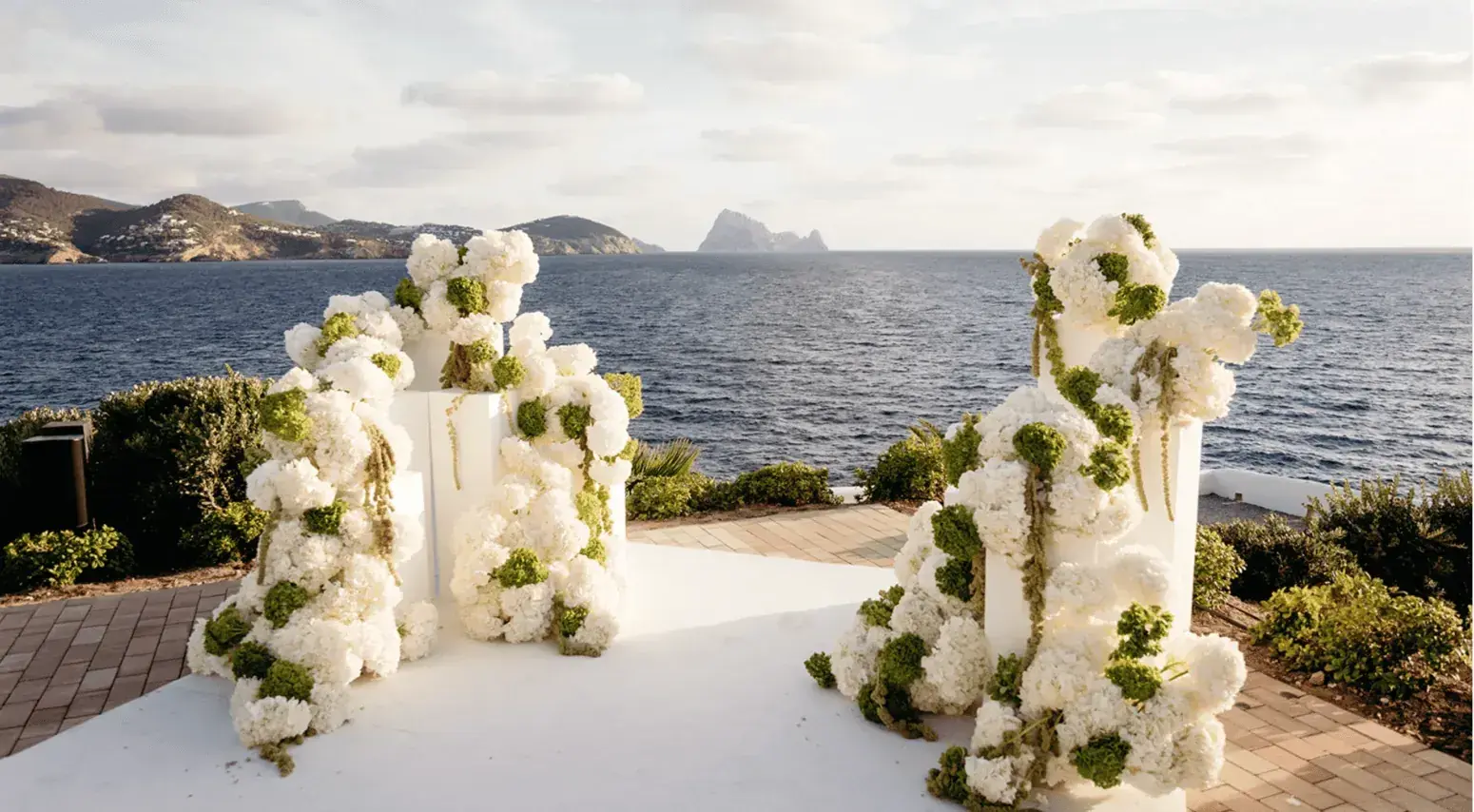
- Any place. A villa garden, a cliff-top facing Es Vedrà, a finca under the olive trees or a beach club at sunset: the ceremony is not tied to a town hall or church.
- Any time. Plan it for the golden hour, about an hour before sunset.
- Your words, your language. Bilingual ceremonies, your own vows, rituals from your families' traditions, readings by friends.
Who leads it
A professional celebrant writes the ceremony with you, usually after one or two conversations about your story, and leads it on the day. Many work in several languages. Some couples ask a friend or family member instead. Because the ceremony has no legal effect, anyone can lead it. See celebrants and officiants.
Ideas to make it yours
- A sand, wine or handfasting ritual
- Letters from parents read aloud
- A unity candle at dusk, or a ceremony that ends right at sunset
- Musicians for the walk down the aisle: a solo violin, a string quartet or Spanish guitar (see ceremony musicians)
The practical side
- Book the registry office at home early: some have waiting lists in summer.
- Bring a copy of your marriage certificate if a venue or church blessing asks for it.
- Shade, water and a short ceremony (20–30 minutes) keep guests comfortable in summer.
Questions
Is a symbolic ceremony legally binding?
No: the legal marriage is the one you register at home. The ceremony in Ibiza is the celebration, and for most couples it is the wedding that matters.
Should we sign the papers before or after Ibiza?
Either works. Before means you arrive married and the ceremony is pure celebration; after means your wedding anniversary is the Ibiza date. Choose what feels right.
Can a friend lead the ceremony?
Yes. A symbolic ceremony has no legal requirements for who leads it.